
What Is It Like to Live in Sherwood, Oregon?
Use this guide to compare Sherwood Oregon property taxes with local proof, decision criteria, source checks, and next steps. Local context: Portland
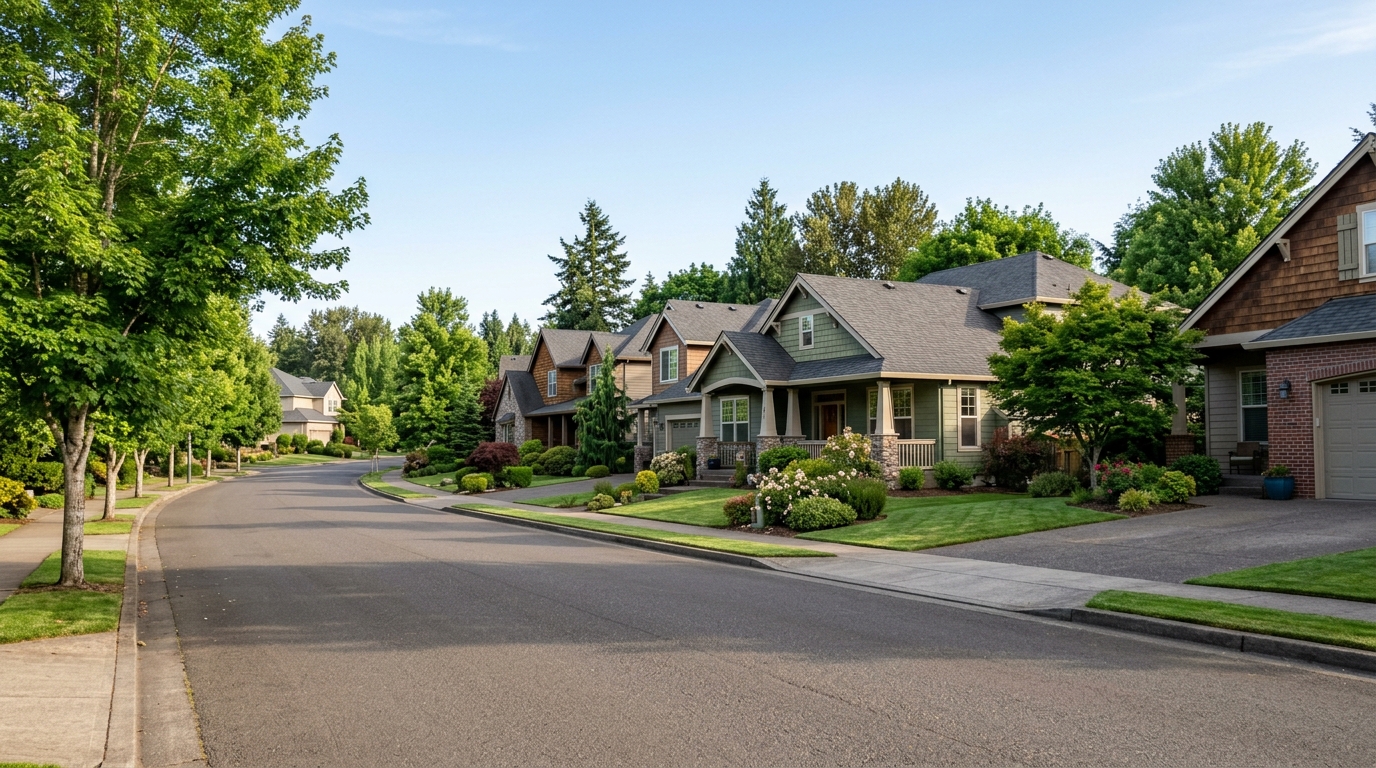
Daily life in Sherwood leans suburban and car-dependent, with a Walk Score of 38, a historic Old Town core, and the Tualatin River National Wildlife Refuge on the edge of town. The commute to Portland is about 26 minutes off-peak by car, and Oregon's Measure 50 rules cap how fast your property taxes can climb, which matters more here than in states with no such cap. Sherwood is growing at the edges through the Brookman annexation and the Tonquin employment area, but the built core stays quiet. The town sits entirely within Washington County, covers just 4.3 square miles, and holds a homeownership rate of 72.3%, well above the U.S. average, so it reads as a settled town of owners rather than a churning rental market. If you want a settled neighborhood with room to breathe and a reasonable Portland reach, Sherwood fits that profile. Just verify the specifics of any address before you commit.
What Should You Verify Before Buying a Home in Sherwood?
This guide is educational and should not be treated as legal, tax, lending, or title advice. Before relying on a property decision, verify the exact address with county records, title documents, HOA materials, district filings, lender estimates, and appropriate professional advisors.
Where Does Sherwood Sit in the Portland Metro and How Far Is It From Downtown?
Sherwood sits entirely within Washington County in the Tualatin Valley, tucked into the southwest corner of the Portland metro along Oregon Route 99W with I-5 accessible just to the east through Tualatin. It borders Tualatin to the north and King City to the northeast, and Highway 99W serves as the main commercial corridor running through town.
The distance most buyers ask about is the one to downtown Portland. That trip is 16.4 road miles, according to Rome2Rio, which translates to roughly a 26-minute drive when traffic is light. During peak commute windows the same stretch stretches longer, since 99W and the I-5 approach through Tualatin both back up, but off-peak the run is genuinely quick for a town that feels this far removed from the city.
Sherwood covers just 4.3 square miles, which is worth sitting with. This is a compact town, not a sprawling suburb. Population density runs about 4,217 people per square mile, so the developed neighborhoods are fairly dense while the town as a whole stays small. If you're relocating from elsewhere in the region, our Portland relocation guide covers how the southwest suburbs compare on commute and price.
Two nearby towns worth understanding as you compare are Tualatin and Tigard, both closer to Portland and both with their own housing character. A buyer weighing Sherwood against those often trades a few minutes of commute for a quieter setting and a different price mix.
What Is the Commute Like From Sherwood, and Is It Walkable?
The typical Sherwood resident spends about 24.1 minutes commuting and drives alone to work, per Census data compiled by Data USA for 2024. That single number tells you most of what you need to know: this is a car-first town, and the average household keeps roughly two cars.
Add rush hour and the 99W corridor plus the I-5 merge through Tualatin will slow you down, so buyers who commute daily should drive the route at 8 a.m. before committing, not at noon when the road is empty.
Transit is the weak point. There is no direct bus from Sherwood to downtown Portland. A transit trip requires a transfer through the Tigard Transit Center and takes roughly an hour and 16 minutes. Local bus lines 93, 94, and 97 stop near SW Old Highway 99W, but the practical reality is that most residents drive.
On walkability, Sherwood scores 38 out of 100 on Walk Score, which classifies it as minimally walkable. Old Town is the exception, where you can reach shops and restaurants on foot, but most neighborhoods require a car for errands. If proximity to Portland transit matters more to you, it's worth comparing with a Tigard real estate agent or a Tualatin real estate agent on how those towns connect.
What Do Homeownership and Home Values Look Like in Sherwood?
Sherwood is a town of owners. The homeownership rate is 72.3%, well above the U.S. average of 65.2%, which reflects a housing stock weighted toward single-family homes and long-term residents.
Homes here have been taking a bit longer to sell. Homes received about two offers on average, and Redfin scored the market 71 out of 100 on its competitiveness scale. That combination points to a market that is active but no longer frantic, where a well-priced home moves in about a month and a buyer usually has room to negotiate rather than waive every contingency.
When you compare price figures across listing portals, be aware that they mix asking prices, sale prices, and automated estimates, so they are not comparable. When you want a real read on what a specific home is worth, the closed-sale medians from the local MLS are the figures to trust.
How Do Oregon Property Taxes Work for a Sherwood Homeowner?
Oregon taxes your home on its assessed value, which is the lower of its real market value or its maximum assessed value. That cap is the single biggest reason a longtime Sherwood owner's tax bill can sit far below what a brand-new buyer would owe on the same street.
Here is how the two-value system works in plain terms. You are taxed on whichever is lower. In rising markets the maximum assessed value is usually lower, so your bill stays gentle even as the home appreciates.
Payment timing follows the statewide Oregon calendar. Tax statements are mailed in late October, and taxes are due by November 15, with the option to pay in three installments due in November, February, and May. If you think your assessed value is wrong, you can appeal to the Washington County Board of Property Tax Appeals by the statutory deadline. One more thing that helps the overall cost picture: Oregon has no statewide sales tax, so the trade-off for a moderate property-tax rate is that everyday purchases are untaxed.
To pull the actual record for any Sherwood home, the Washington County Department of Assessment and Taxation is the office to use. On the property record you want to read the assessed value versus real market value, any special district levies, and the tax code area, since those levies vary across the county and drive the difference between two similar homes. For a fuller walk through the math, how Oregon's Measures 5 and 50 shape your tax bill goes deeper.
What Growth and Development Are Reshaping Sherwood?
Sherwood is growing at its edges while its core stays largely built out, and three areas define the change: the Brookman Addition, the Tonquin Employment Area, and the Sherwood West urban reserve.
The Brookman Addition is the most active. The Sherwood City Council approved annexing about 92.3 acres in the Brookman Concept Plan area just south of the city, and it is now under residential build-out. Notably, in April 2026 the council said it felt compelled to annex by Senate Bill 1573, a state law that removed cities' ability to put annexations to a local vote. If you are considering a new home in the Brookman area, know that residents raised a live concern at the July 21, 2026 council meeting: the new neighborhood has only one access road and lacks connecting trails, which they called unsafe for cyclists and strollers. The city has a feasibility study on additional routes projected to wrap in mid-August 2026. That is exactly the kind of detail to verify before buying in a brand-new subdivision.
The Tonquin Employment Area is the jobs piece. The mayor has cited a planned one-million-square-foot high-tech manufacturing facility from Jordan Schnitzer in the area, though a completion date has not been published. For a buyer, more nearby employment can support long-term home demand, but the timeline is uncertain enough that it should not be the basis for a purchase decision today.
Sherwood West, at 1,291 acres, is the larger urban reserve next to the city. It sits outside the urban growth boundary and has only reached preliminary concept planning, so it is a long-horizon area, not near-term inventory.
What Is Everyday Life Like in Old Town and Around the Tualatin River Refuge?
Daily life in Sherwood centers on Old Town, the historic core, and slows down considerably from there. Old Town is where the town is genuinely walkable, with shops and restaurants clustered close enough to reach on foot, which is why it functions as Sherwood's gathering point despite the town's low overall Walk Score of 38.
The defining natural landmark is the Tualatin River National Wildlife Refuge on the edge of town. It is one of a small number of urban national wildlife refuges in the country, and it gives residents accessible trails, birdwatching, and open space without leaving the area. For buyers drawn to the Northwest for outdoor access, that refuge is a concrete daily-life amenity rather than a distant attraction.
Beyond that, Sherwood reads as a settled residential town. The car-first pattern shapes routine: most errands, schools, and jobs involve a short drive rather than a walk, and the average household runs about two cars. That is a genuine trade-off worth naming. You gain quiet neighborhoods, space, and a strong ownership base, and you give up the walk-everywhere density of an inner-Portland neighborhood.
Local civic engagement runs high. If you are weighing Sherwood against nearby options like West Linn on the other side of the river, comparing notes with a West Linn real estate agent can help you sort commute and price differences.
Next Step
If you are weighing a community in Portland, OR, reach out for current rules, inventory, costs, and daily-fit details before you decide.
Phone: (503)-449-4022
Email: ross@ownitnorthwest.com
Frequently Asked Questions
How far is Sherwood, Oregon from downtown Portland?
Sherwood is about 16.4 road miles from downtown Portland, roughly a 26-minute drive off-peak along Oregon Route 99W and I-5 through Tualatin. That commute corridor is worth stress-testing during peak hours before committing to the area, because the drive can stretch considerably on weekday mornings heading north.
Is Sherwood, Oregon a walkable city?
Sherwood is generally considered car-dependent outside of its historic Old Town core, where a concentration of shops and restaurants makes shorter errands more manageable on foot. Buyers who prioritize daily walkability should focus specifically on properties close to that downtown district rather than assuming the entire city shares that characteristic.
What is the homeownership rate in Sherwood, Oregon?
Sherwood consistently reports a homeownership rate above the Oregon statewide average, reflecting its character as a family-oriented suburban community with a relatively high share of single-family housing stock. That demographic tends to support neighborhood stability, which is one factor property tax assessors and lenders alike factor into long-term valuations.
How are property taxes calculated for a home in Sherwood?
In Sherwood, the applicable tax rate is the sum of levies from overlapping districts, Washington County, the City of Sherwood, local school districts, and any special service districts, applied against that assessed value. Because assessed value and real market value can diverge significantly in appreciating markets, two homes with similar sale prices can carry meaningfully different tax bills depending on how long each has been held.
Is Sherwood, Oregon growing, and what new development is planned?
Sherwood has been one of Washington County's faster-growing cities, and the city has an Urban Reserve Area to the west, known informally as the Sherwood West expansion, that is intended to accommodate future residential and mixed-use growth over coming decades. The pace and phasing of that development depends on infrastructure funding, urban growth boundary amendments, and state land-use approvals, so the timeline remains subject to change. Buyers considering undeveloped or fringe-area parcels should review current Washington County planning documents to understand what is entitled versus what is still speculative.
Talk to the team
Ready to make your move in Oregon or Washington?
Whether you’re buying, selling, or just thinking it through, the Own It Northwest team is happy to talk. No pressure — just clear answers from people who know the market.